
12 Charming Clay Crafts House Models You Can Create
You can craft 12 charming clay house models including classic cottages with sloped tile roofs, whimsical hobbit homes, illuminated lantern houses, fairytale mushroom cottages, and modern minimalist designs using polymer or air-dry clay. Experiment with techniques like textured walls, patterned tile assembly, modular block construction, and layering clay for ornate trims or thatched effects. Sculpt windows, doors, and detailed facades for added realism. If you continue, you’ll uncover creative tips for architectural detail and clay model variety.
Experiment with techniques like textured walls, patterned tile assembly, modular block construction, and layering clay for ornate trims or thatched effects. Sculpt windows, doors, and detailed facades for added realism. If you continue, you’ll uncover creative tips for architectural detail and clay model variety.
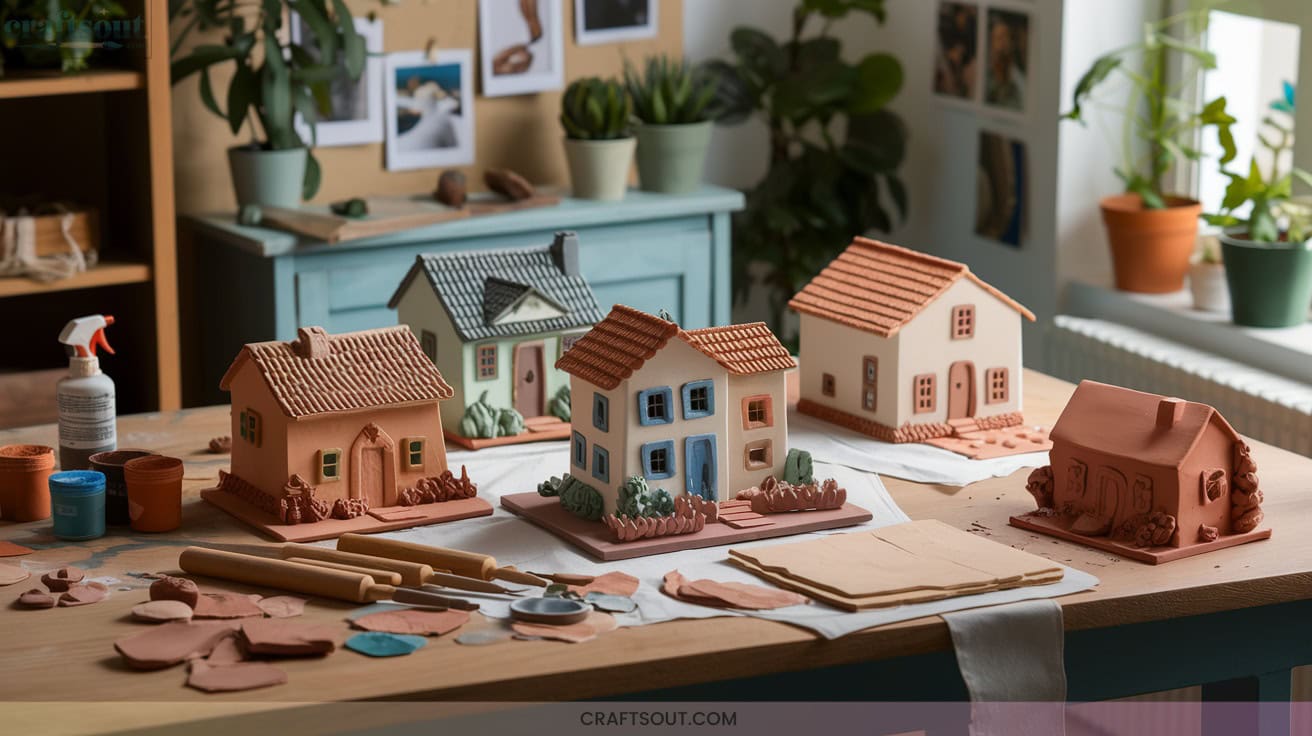

12 Charming Clay Crafts House Models You Can Create: You can craft 12 charming clay house models including classic cottages with sloped tile roofs, whimsical hobbit homes, illuminated lantern houses, fairytale mushroom cottages, and modern minimalist designs using polymer or air-dry clay. Experiment with techniques like textured walls, patterned tile assembly, modular block construction, and layering clay for ornate trims or thatched effects.
1. Classic Cottage Clay House

A classic cottage clay house relies on sloped clay tile roofs and earthy ceramic exterior walls to deliver both structural integrity and a rustic, timeless aesthetic.
Sloped clay tile roofs and earthy ceramic walls define the structural strength and enduring charm of a classic cottage clay house.
You’ll start by selecting high-quality, locally sourced clay for sustainability and durability.
Handcrafting walls and roofing tiles guarantees each component’s uniqueness and enhances character.
Employ traditional pottery techniques to shape small square windows and sturdy wooden doors, then integrate handcrafted ceramic ornaments for a custom finish.
Arrange clay tiles in innovative patterns for both function and visual interest.
Hand-painted details and earthy tones finalize a design that’s energy-efficient, resilient, and harmonizes with natural surroundings.
2. Whimsical Hobbit House

Start by selecting earth-toned clay to replicate the organic palette of a whimsical hobbit house, focusing on hues like mossy green, deep brown, and golden yellow.
Sculpt a rounded base, integrating curved architecture and arched doorways with circular windows for authenticity.
Use modeling tools to etch rustic wooden textures and stonework details directly into the clay.
Shape a thatched roof by layering fine clay strands, ensuring natural variation.
Embed miniature foliage or moss to enhance nature integration.
For interiors, apply pastel clay for cozy finishes.
Prioritize craftsmanship in every element, capturing Tolkien-inspired storybook charm through material precision and innovative construction.
3. Illuminated Lantern House

Shifting from organic, storybook-inspired forms, illuminated lantern houses emphasize structural clarity and function, relying on precisely chosen clay types like polymer or air-dry clay for ideal light diffusion and stability.
Illuminated lantern houses embrace structural clarity, using select clays for both luminous diffusion and enduring architectural stability.
Begin by constructing a rigid base with foam core, then layer clay for precise wall definition and integrate open windows for optimized luminance.
Craft a detachable or vented roof to facilitate LED installation and airflow.
Enhance architectural impact with arches or columns, integrating cultural or nature-inspired motifs for thematic cohesion.
Finish with UV-resistant varnish for durability.
Experiment with scale and lighting placement to achieve innovative visual effects in diverse environments.
4. Fairytale Mushroom House

Whimsy meets technique in the construction of fairytale mushroom houses, where air dry clay, polymer clay, or homemade paper clay allow precise modeling of stems and caps atop stable bases like miniature glass jars.
Start by selecting a jar, then build internal support with tape, cardboard, or aluminum foil.
Shape the stem and cap using clay tools, referencing real mushroom forms—chanterelles or toadstools—for authenticity.
Apply a hot glue gun for secure assembly.
Once dry, use acrylic paints and fine brushes for vivid detail, incorporating glitter or beads as desired.
Follow detailed tutorials, experiment with color schemes, and always allow adequate drying time.
5. Modern Minimalist Clay Home

Sustainability anchors the modern minimalist clay home, where natural clay plaster, microcement flooring, and oak joinery define both structure and style.
You’ll leverage advanced material continuity and precision detailing to achieve seamless interfaces.
Optimize your model by integrating eco-friendly insulation and breathing structures for humidity regulation.
Amplify spatial clarity with pivot doors and pod-based wetrooms.
To innovate:
- Apply microcement for matte, seamless flooring.
- Use natural clay plaster for insulation and tactile warmth.
- Incorporate oak joinery for visual and structural cohesion.
- Design with integrated lighting to accentuate minimalist forms.
This process champions sustainability and architectural clarity.
6. Rustic Cabin Model

A rustic cabin model begins with selecting your clay—polymer or air dry clay offer durable, workable bases for constructing the primary structure.
Roll and shape slabs for the walls, cutting apertures for doors and windows.
Incorporate twigs or sticks for authentic log effects.
Use thicker clay coils at corners for stability and visual realism.
Imprint bark-like textures and apply clay coils for trim.
Form roof planks by rolling clay to even thickness, scoring grooves for dimension.
Add chimneys and landscape with miniature rocks or clay foliage.
Paint with earthy tones, wipe for weathering, and seal with matte varnish for authenticity.
7. Victorian-Style Miniature

Victorian-style miniatures demand careful attention to architectural detail and mastery of clay manipulation.
Start by selecting your preferred clay—air-drying, polymer, or earthenware for authenticity.
Use slab construction to assemble asymmetrical facades and steeply pitched roofs, then layer clay for window bays and ornate trims.
Employ texturing tools to replicate brick and wood motifs, enhancing realism before curing or drying.
Once hardened, apply bold acrylic paints for a vibrant finish.
For best results, focus on:
- Slab construction for structural base
- Layering for dimensional trims
- Texturing tools for surface effects
- Vivid painting to highlight details
8. Tudor-Inspired Clay House

Shifting from ornate Victorian forms, Tudor-inspired clay houses emphasize structural authenticity and historic detailing.
Begin by shaping the base with polymer or air-dry clay, sculpting steeply pitched, multi-gabled roofs and tall, narrow window recesses.
Mimic half-timbered framing with shallow grooves and overlay clay strips for a realistic effect.
Replicate clay tile roofing by texturing or adding individual tiles.
Integrate cross gables for added architectural interest.
Once dry, hand-paint vibrant facades and frame details to evoke Tudor charm.
Experiment with modern color palettes and textures for innovative interpretations.
This hands-on process fosters skill development and highlights Tudor architecture’s timeless elegance.
9. Treehouse Clay Sculpture

Transforming polymer clay into a treehouse sculpture requires careful material selection and precise technique.
Crafting a polymer clay treehouse demands intentional material choices and meticulous sculpting for truly enchanting results.
Begin by conditioning Sculpey 3 polymer clay, ensuring ideal pliability for intricate shaping.
Use Golden Mediums GAC 100 to seal natural stones, creating a stable base and enhancing clay adhesion.
Once your structure takes form, employ slip technique for secure attachment of architectural and fantasy details.
Accentuate bark textures with specialized tools, then highlight features with Pearl Ex pigments for a metallic sheen.
For innovative presentation, consider:
- Diorama forest base
- Integrated LED lighting
- Live moss accents
- Concealed interactive compartments
10. Coastal Beach Hut

How can you capture the essence of a coastal beach hut in polymer clay?
Start by conditioning your clay and forming a miniaturized structure with precise clapboard timber texturing for authentic siding.
Sculpt a pitched roof, then apply bright, contrasting colors to evoke traditional seaside vibrancy.
Incorporate large window openings to reference panoramic sea views.
For innovation, experiment with mirrored or metallic clays to mimic contemporary architectural trends.
Use fine tools to etch plank details and add minimalistic accessories—benches or storage chests—for functional realism.
Integrate locally inspired motifs, reflecting both sustainability and global coastal influences, for a modern, evocative model.
11. Fantasy Castle Model

A fantasy castle model demands precise planning and material selection to achieve architectural authenticity and imaginative flair.
Start with modular construction—individual blocks allow extensive customization in both digital and physical formats.
Integrate architectural diversity, such as towers and fortified gates, and choose materials that hold intricate brick textures for realism.
Apply high-quality PBR textures and blend decals for visual depth.
For innovative creators, consider these essential steps:
- Select modular components and layout for structural flexibility.
- Employ detailed textures and materials for tactile authenticity.
- Incorporate scene assets like doors and cannons.
- Display the model on a stable base for best visualization.
12. Urban Row House Design

Curiously, when you approach urban row house design, prioritize material selection and structural planning to achieve both historical accuracy and practical efficiency.
Prioritize smart material choices and thoughtful structure to balance authentic history with practical efficiency in urban row house design.
Start with a narrow clay base—no wider than 25 feet—to mirror authentic footprints.
Sculpt load-bearing brick walls and attach party walls to simulate shared structural support.
Replicate stone or brownstone facades for period-specific detailing, and maintain uniform rooflines to capture streetscape consistency.
Integrate multi-level floor plates, maximizing interior volume within a compact footprint.
For added realism, texture surfaces to indicate brickwork or stone, and use modular construction for ease of assembly.
This process maintains historical integrity while enabling innovation.
Frequently Asked Questions
What Type of Clay Is Best for Beginners in House Modeling?
You should select polymer clays like Sculpey or FIMO for house modeling. They provide ideal firmness, precise detail retention, and easy oven-curing. Alternatively, use air-dry clays for rapid prototyping—just guarantee airtight storage and thorough kneading pre-modeling.
How Do You Prevent Air Dry Clay From Cracking?
To prevent air dry clay from cracking, you’ll control drying speed with damp coverings, apply clay in thin layers, and achieve even exposure. Score and use slip for joints, incorporate conditioners, and monitor consistency for ideal structural integrity.
Can Children Safely Participate in Clay House Crafting?
Curious if children can safely craft with clay? Yes—when you select non-toxic clays, enforce rigorous hygiene, supervise tool usage, and implement age-appropriate techniques, you transform clay crafting into an innovative, secure, and skill-building process for young creators.
What Paints Work Best on Dried Clay House Models?
You’ll achieve best results using acrylics for their superior adhesion and vibrancy. Chalk paint delivers a matte, rustic effect, while Rub ‘n’ Buff adds metallic texture. Always seal your innovations to enhance durability and color longevity.
How Do You Store Leftover Clay to Keep It Soft?
Don’t you want your clay ready for your next project? You’ll wrap air dry clay in cling wrap with water drops, use airtight bags for ceramic clay, and store polymer clay in soft, non-reactive plastic containers. Innovate your storage!
Conclusion
With clay in your hands, the possibilities are as endless as your imagination. Whether you opt for a whimsical hobbit house or a modern minimalist home, each model lets you experiment with textures, glazes, and sculpting techniques.
Don’t just craft—engineer cozy chimneys, sturdy walls, and intricate windows. Isn’t it fascinating how a lump of clay transforms into a storybook dwelling? So, gather your tools, select your clay body, and let your architectural creativity take shape.


